Putting a Bow on 2022

January 23, 2023

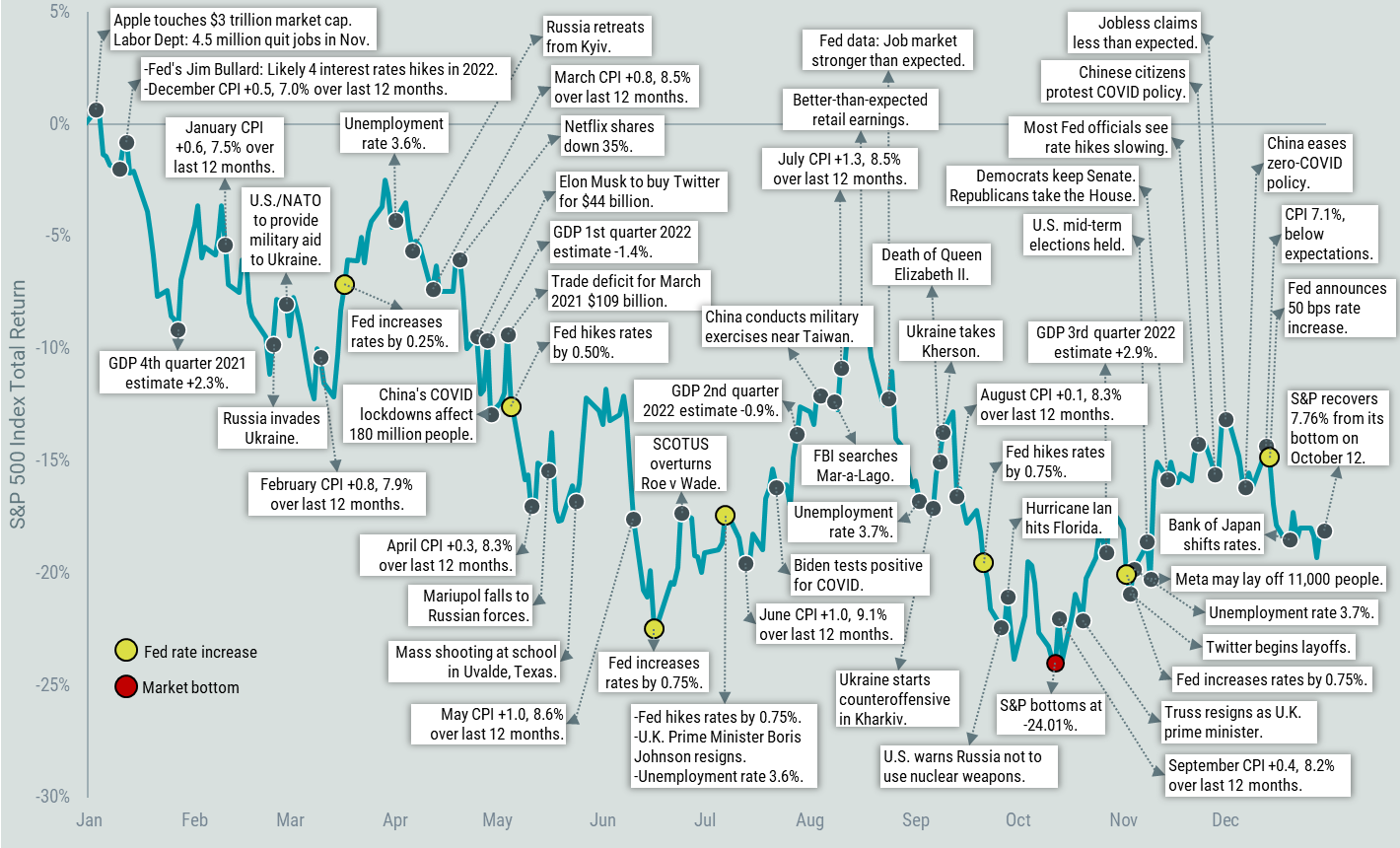
Although 2022 was a year marked by memorable events, but any investors might wish they could forget it, considering one prominent gauge of U.S. stock market performance — the S&P 500 ® Index — ended the year in bear market territory.

Although each taxable account and each client are different, we strive for tax-efficiency annually. As we moved forward from year-end 2021, our forecasted market environment saw the need to significantly reposition our portfolios.

In the following Figure 1 , we offer a look back across 2022, plotting the cumulative daily return for the S&P 500 along with a host of notable headlines.
Over these three years, there was news and changing conditions that contributed to market volatility. The pandemic, the ensuing economic shutdown, rising inflation and the Federal Reserve’s actions to fight it are just examples.

Affinity Capital exited positions early in 2020 as the scale of the COVID pandemic affected the markets. We slowly re-entered during the Dow Jones Industrial Average thousand-point drops.

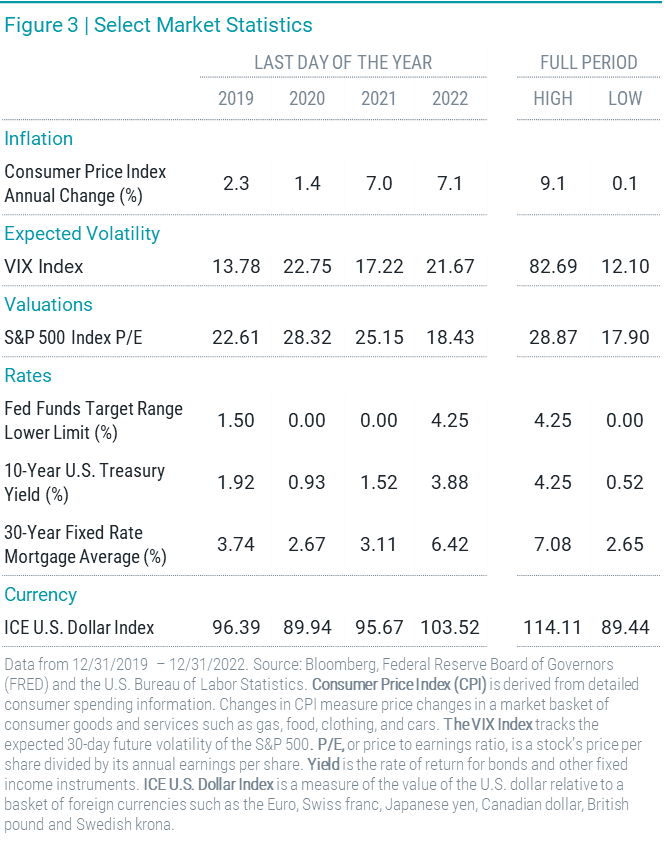
In Figure 3 , we put the period in greater context by presenting a selection of notable statistics showing where each stood at the end of 2019 and each year since.

The full-period highs and lows helped to unmask the changes that were anything but linear. Between these three years, we saw times of higher volatility, higher stock valuations and lower interest rates than we saw at the end of 2022.

In the first quarter of 2022, we exited traditional bonds whose value is inversely affected by rising interest rates. We also exited small and mid-size company funds as well as international position and have moved to higher income producing securities to take advantage of climbing interest rates.
A Few Thoughts for 2023

Looking ahead, we will face many of the same risks and uncertainties of 2022 as it remains to be seen how far the Federal Reserve will go in its campaign to curb inflation, how higher interest rates will affect consumer spending and company earnings, how the war in Ukraine will play out, or what will result from China’s shift away from its zero-COVID policy.

History does offer perspective, though, for investing in tough times. We can expect more volatility in 2023, but the market has already priced in lower expectations, and valuation ratios are more attractive.

If we consider previous periods when economic uncertainty was high, the markets have historically rallied well before those uncertainties subsided — once light appeared at the end of the tunnel and signs of improving conditions were apparent. There is a possibility of continued weakness in the technology heavy Nasdaq 100 stocks. This may be another shoe to drop in the minus 10 to 15% range. As we realign our portfolios, we see periods of continued weakness in the short-term which will heighten investor emotions.

Just a year ago markets were at historic highs after a century of world wars, assassinations, oil embargos, terrorist attacks, a mortgage crisis and so much more. The markets are resilient and will continue to build wealth for us.

 

By Ashley Cowan July 30, 2026
The Federal Reserve concluded its meeting by leaving short-term interest rates unchanged at 3.50% to 3.75%. The decision was widely anticipated and reflects the Fed’s continued effort to balance slowing inflation with an economy that remains remarkably resilient. The economic data released today helps explain that decision. The U.S. economy expanded during the second quarter, although at a more moderate pace than earlier in the year. While the headline growth rate slowed, the underlying picture remains encouraging. Consumer spending continued to be a significant driver of economic activity, businesses are still investing, and the labor market has remained healthy. Much of the slower overall growth appears to reflect temporary factors rather than a broad weakening of the economy. Inflation also continued to move in the right direction. Price pressures have eased considerably from their peak, although inflation remains above the Federal Reserve’s long-term target. That leaves policymakers in a position where they can afford to be patient while continuing to evaluate incoming economic data. Taken together, these developments suggest the economy is transitioning toward a more sustainable pace of growth rather than falling into recession. While risks remain, particularly from geopolitical events, government policy, and persistent inflation in certain sectors, the overall economic backdrop continues to be relatively constructive. For investors, this environment is likely to produce periods of market volatility. Financial markets constantly reassess expectations for interest rates, inflation, corporate earnings, and economic growth. Each new report has the potential to shift those expectations, resulting in short-term market swings. That is why it is important not to overreact to any single Federal Reserve meeting or economic report. History has repeatedly demonstrated that successful investing is built on discipline rather than prediction. Markets will always experience periods of uncertainty, but long-term investment success comes from maintaining a diversified portfolio that is aligned with your financial goals, risk tolerance, and time horizon. While today’s economic reports offer additional insight into where the economy may be headed, they do not change our investment philosophy. We continue to evaluate the broader economic environment, corporate earnings, valuations, and long-term trends rather than focusing on short-term headlines. The economy has slowed from the exceptionally strong pace of the past several years, but it continues to demonstrate resilience. Inflation has improved, interest rates remain restrictive, and the Federal Reserve has the flexibility to respond as new information becomes available. Those are all positive developments for investors seeking a more stable economic environment. As always, we will continue to monitor economic developments carefully and make thoughtful portfolio decisions when warranted. Our focus remains on helping clients achieve their long-term financial objectives, regardless of the latest headlines.
July 9, 2026
Markets navigated a volatile week as escalating tensions between the United States and Iran collided with encouraging domestic economic data and renewed enthusiasm for artificial intelligence-related names. The result was a market that whipsawed day to day but ultimately showed underlying resilience — and one we monitored closely on your behalf throughout the week. Equities: Volatile but Holding Up Major indices experienced sharp intraday swings this week. The Dow Jones Industrial Average fell as much as 1.1% in a single session, dropping over 855 points at its intraday low, while the S&P 500 and Nasdaq Composite showed more mixed results, with the tech-heavy Nasdaq finishing higher on strength in AI-related names. Later in the week, sentiment improved meaningfully as a resurgence in technology companies powered a broader rebound, with the Nasdaq 100 adding roughly 1% and semiconductor stocks climbing around 4%. Chip names whipsawed, having sold off sharply earlier in the week before staging a partial recovery. We continued to track these swings across portfolios throughout the week and saw no cause for reactive changes. Geopolitics Remains the Dominant Wildcard The renewed conflict between the U.S. and Iran was the week's central story, and one we are following closely for downstream portfolio effects. The United States launched fresh airstrikes against Iran, and Tehran responded by targeting Gulf-region interests, following a breakdown of the fragile ceasefire that had been in place. This escalation had an immediate and direct economic effect: energy markets. Crude oil prices spiked sharply, with U.S. benchmark crude rising over 4% and global benchmark crude rising over 5% in a single session, briefly rattling equity markets and lifting energy-sector shares while pressuring more rate-sensitive corners of the market. We noted markets showing a degree of "shock fatigue" as the week progressed, looking past the headlines, though we remain attentive to the possibility of renewed volatility in oil and safe-haven assets should the conflict widen further. The Economic Backdrop Remains Constructive Away from the geopolitical noise, we continue to see an underlying economic picture that supports a "soft landing" narrative. Weekly initial jobless claims came in at 215,000, a six-week low and below economist estimates, reinforcing continued labor market strength. This follows a broader trend we have been tracking: monthly job gains so far in 2026 have averaged roughly 92,000, well above last year's pace, even as wage growth of about 3.5% year-over-year has remained contained rather than accelerating. This combination, steady hiring without runaway wage pressure, is exactly the kind of environment we believe the Fed wants to see as it weighs its next move. On the Fed itself, minutes from the June FOMC meeting showed officials remain divided on the path forward for rates, with inflation data likely to be the deciding factor going forward. Markets currently assign only about a 28% probability to a rate hike at the July meeting, and we are positioning our outlook accordingly, expecting the Fed to largely stay on hold in the near term. What We're Monitoring on Your Behalf Heading into next week, we are closely tracking the June CPI release and Fed Chair testimony scheduled for mid-July, along with the unofficial kickoff of Q2 earnings season as major banks begin reporting. We view corporate earnings as an important test of whether the strong AI-driven capital spending narrative can translate into sustained profit growth, with Wall Street currently projecting Q2 S&P 500 earnings growth in the low-to-mid 20% range, disproportionately driven by AI-related capital expenditure. We will continue to assess how these developments intersect with account positioning and will reach out proactively if we believe adjustments are warranted. Our Perspective Weeks like this are a good reminder that headline-driven volatility and underlying economic fundamentals often tell different stories. While geopolitical developments can create short-term turbulence — particularly through the energy channel — we continue to view the domestic labor market and corporate earnings backdrop as constructive. We remain engaged and continually monitoring client accounts through periods like this, and our focus stays on long-term financial goals rather than reacting to day-to-day headlines. Please don't hesitate to reach out with any questions about how these developments may affect your individual financial plan.
June 25, 2026
Markets continue to navigate a mix of encouraging economic news and ongoing global uncertainty. While investors remain optimistic about the long-term outlook for the economy and corporate earnings, headlines from around the world continue to influence day-to-day trading. One of the biggest factors remains geopolitics. Although tensions in the Middle East have eased somewhat, investors are still watching developments closely because they can affect oil prices, inflation, and ultimately interest rates. Lower oil prices this week have helped calm some inflation concerns, which has been a positive for the broader market. Technology also remains in the spotlight. Strong earnings and continued investment in artificial intelligence have supported parts of the market, although investors are becoming more selective as valuations in some technology companies remain elevated. Looking ahead, markets will continue to focus on inflation data and the Federal Reserve's next steps. If inflation continues to moderate, it could provide support for stocks. However, unexpected developments overseas, changes in energy prices, or shifts in economic data could still create short-term volatility. While short-term market movements can be unsettling, they are a normal part of investing. Rather than reacting to daily headlines, we remain focused on building portfolios designed to weather changing market conditions and help you pursue your long-term financial objectives. Maintaining a disciplined, diversified investment strategy remains one of the most effective ways to navigate uncertainty. As always, if your financial situation or goals have changed, we're here to help ensure your plan continues to align with what matters most to you.